02 September 2026
Choosing the right charger determines how quickly, safely and conveniently you can charge your EV. The differences between the available options relate to power output, connector type, installation method and portability – and each of these factors directly affects EV charging times and everyday convenience. Below you’ll find a practical ranking of the best chargers for 2026, along with a comparison of specifications, costs and usage scenarios.
What should you consider choosing an EV charger?
Before we move on to specific models, it’s worth understanding the three key criteria that determine which electric car charger to choose. Charging power affects how quickly the battery is recharged. The connector type determines compatibility with your vehicle. The type of device – a wallbox or a portable charger – determines the convenience and flexibility of everyday use.
Each of these factors affects the actual charging time, the safety of the installation and the running costs. A charging cable is an essential accessory, and the quality of the cable’s construction affects safety during use – when choosing a cable or charger, pay attention not only to the power rating, but also to certifications, safety features and IP rating.

Charging power – 3.6 kW vs 7.2 kW vs 11 kW vs 22 kW
Charging power has the greatest impact on how long your car needs to remain plugged in. The differences are significant:
- 3.6 kW (alternating current, single-phase, 16A) – the AC 230V 16A charging cable has a power rating of 3.6 kW. For a 60 kWh battery, a full charge will take approx. 16–17 hours. Level 1 charging takes between 10 and 12 hours for smaller batteries. This is sufficient for overnight charging with low daily mileage.
- 7.2 kW (1-phase, 32A) – the single-phase cable limits the charging power to approximately 7.4 kW. With a 60 kWh battery, charging takes around 8–9 hours. A Type 1 cable can charge at up to 7.4 kW, making this the maximum charging level for vehicles with a Type 1 connector.
- 11 kW (3-phase, 16A) – Level 2 charging takes between 2 and 6 hours, depending on the battery capacity. A 60 kWh battery will charge in around 5–6 hours. This is the optimal choice for most domestic three-phase installations.
- 22 kW (3-phase, 32A) – a Type 2 cable charges at up to 22 kW. A 60 kWh battery will be fully charged in approx. 3–4 hours. The 3-phase cable allows charging at both 11 kW and 22 kW. To charge at full power, you’ll need the appropriate electrical infrastructure (three-phase) and an on-board charger in the vehicle that supports this power rating.
Installation costs rise with power output – a higher maximum power rating means thicker cables, more robust safety measures and, in some cases, an upgrade to the electrical connection. If your car supports a maximum of 11 kW AC, investing in a 22 kW installation will not bring any real benefits. The charging power depends on the number of phases supported by the cable – match it to your needs and the capabilities of your installation.

Connector type – Type 1 vs Type 2 vs GB/T
Connector compatibility is essential – charging is impossible without the correct plug. Charging cables must comply with IEC 62196 standards.
-
Type 1 (SAE J1772) - mainly used in older electric car models imported from the US and Asia. Type 1 charging cables are primarily intended for older electric car models, such as the Nissan Leaf (pre-2018), Mitsubishi i-MiEV and Chevrolet Volt. It offers single-phase AC charging up to 7.4 kW.
-
Type 2 (Mennekes) - the Type 2 cable is the standard connector in Europe. Type 2 to Type 2 is the standard for most new electric cars. It supports both single-phase and three-phase charging, up to 22 kW in standard configurations. In Poland, Type 2 dominates both in wallboxes and at public charging stations.
-
GB/T - a Chinese standard, rarely encountered in Europe. It has its own connectors for both AC and DC.
It is also worth mentioning the DC connectors used in fast chargers: the CCS plug supports charging up to 170 kW, whilst the CHAdeMO plug allows charging up to 50 kW. A fast charger can charge up to 80% in 30 minutes, whilst Level 3 charging takes between 15 minutes and 1 hour. You’ll find these standards at public charging stations along motorways and expressways, not in home chargers.
On the EU electric car market, the vast majority of new models – including Tesla, Renault and Volkswagen vehicles – use a Type 2 connector. If you own an older vehicle with a Type 1 connector, you’ll need a dedicated cable or adapter.
Portable charger vs wallbox – which to choose?
The choice between a portable charger and a wallbox depends on your driving style, where you park and your expectations regarding convenience.
Portable charger - a versatile device that allows you to charge your vehicle in various locations. Schuko, CEE 3-pin or CEE 5-pin plugs ensure compatibility with different power sources. It’s ideal for electric car owners without a fixed parking space or those who travel frequently. The disadvantage is usually lower power output (3.6–11 kW) and the need to set up the equipment each time.
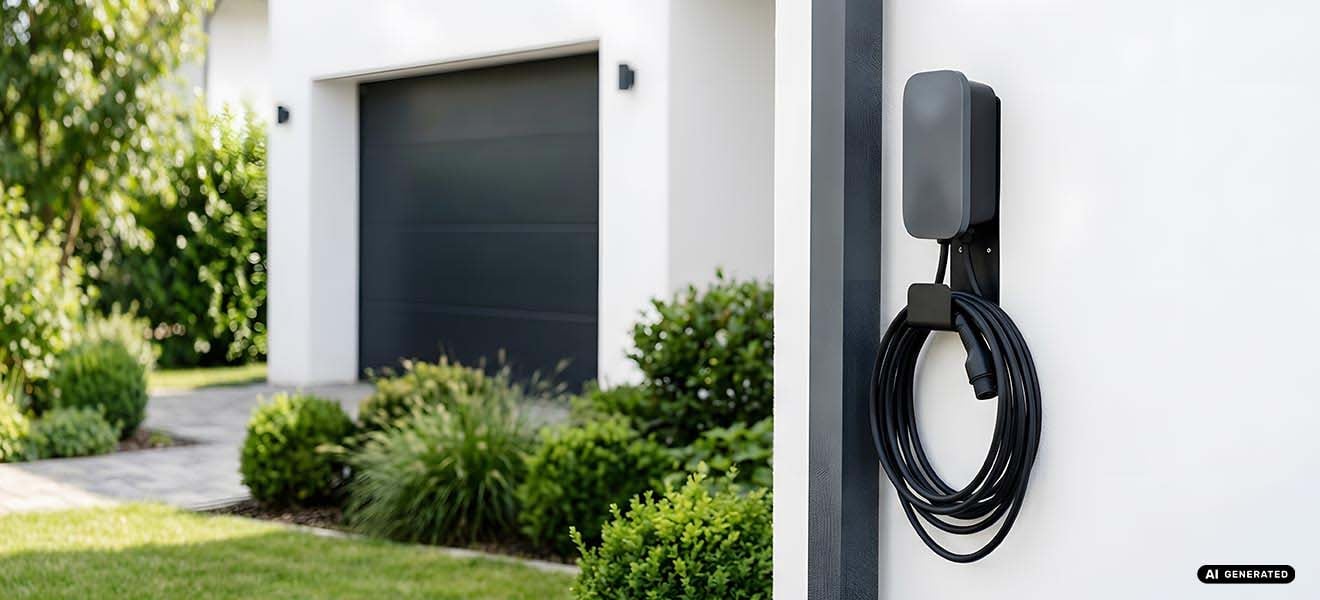
Wallbox - a fixed solution mounted on a garage wall or the external wall of a building. It offers higher charging capacity (usually 11–22 kW), an aesthetically pleasing installation and convenience – you simply need to connect the charging cable to the vehicle. The purchase and installation costs are higher, but the charging process is made as simple as possible.
The cost of a portable charger is usually less than 230 EUR for a basic unit, whilst a wallbox, including installation and accessories, costs the equivalent of 460–2,000 EUR (depending on the complexity of the installation, this cost may increase). The cost of charging depends on the charging method chosen – a wallbox connected to a night-time tariff allows for significant savings.

Electric car charger ranking - TOP 10
The ranking below covers chargers available on the EU market in 2026, assessed in terms of power, build quality, safety features, functionality and value for money. The top five are Akyga products – tried-and-tested solutions offering high build quality, a wide range of safety features and a 24-month warranty. Positions 6–10 feature selected competitors’ products from various price segments.

Akyga AK-EC-21 Wallbox Type2 - a 11 kW stationary wallbox charger with a 5-metre Type 2 cable, designed for convenient charging of electric cars at home, in the garage or in a private parking space. The device features RFID card authorisation, IP54 protection and a comprehensive set of safety features, combining ease of use with reliable everyday performance.
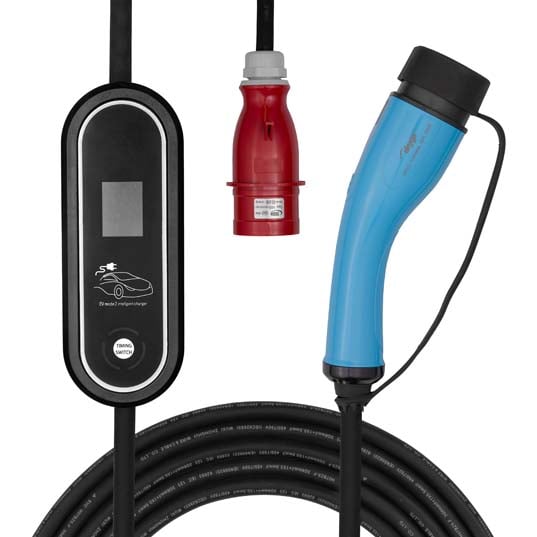
Akyga AK-EC-22 CEE 5pin / Type2 - a 22 kW mobile EV charger with a three-phase CEE 5-pin plug and a Type 2 connector, enabling fast charging of an electric car from a three-phase supply. Current adjustment options of 10/16/24/32 A, an LCD display, safety features and a carrying case make this a convenient solution for the home, garage and when travelling.

Akyga AK-EC-19 Type2 - a 3.8 kW portable EV charger with a Type 2 connector and a 230 V mains plug, designed for charging electric cars and plug-in hybrids. With adjustable current settings of 8/10/13/16 A, an LCD display, a full set of safety features and a 5 m cable, the charger is easy to use and allows you to conveniently adapt the charging parameters to suit your installation.
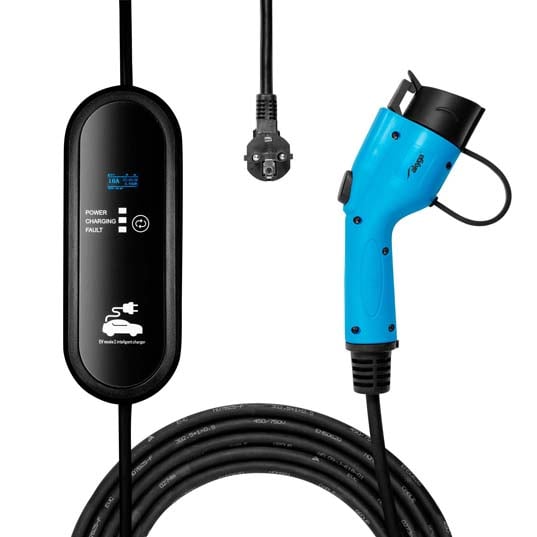
Akyga AK-EC-18 Type1 - a 3.8 kW mobile EV charger with a Type 1 (American) connector and a 230 V mains plug, designed for electric vehicles and plug-in hybrids fitted with an older socket standard. It features current settings of 8/10/13/16 A, an LCD display, a full range of safety features and an IP54 protection rating, ensuring simple operation and stable charging in a variety of conditions.

Akyga AK-EC-15 CEE 3-pin / Type1 - a 7.2 kW portable EV charger with a Type 1 connector and a CEE 3-pin plug (camping type), designed for electric vehicles requiring charging currents of up to 32 A. An LCD display, a full range of safety features, IP54 protection and a 5-metre cable make it easy to monitor charging parameters and allow for efficient use of a charging system with the appropriate power output.

Wallbox BESEN 11 kW - a popular wallbox with smart features (Wi-Fi, app), a Type 2 connector, IP66 rating and a built-in power plug. The device is characterised by easy installation and intuitive control via a dedicated mobile app, allowing for remote management of the charging process.

Zencar model C30 - a portable three-phase Type 2 charger with a power output of 22 kW. The product is highly weather-resistant thanks to its IP66 rating. With adjustable charging current and a compact design, the Zencar ensures convenience and efficiency when charging in various locations.

GreenCell EV16 - a portable charger with a Type 2 cable. It offers 3.6 kW of power, operates on a single-phase supply and supports a charging current of 16 A. The long 6.5 m cable makes it easier to connect the car, whilst the IP66 protection rating ensures protection against dust and water.

Dé M2D07B6 - a portable EV charger with a power output of up to 7.4 kW and a Type 2 connector. The model operates on a single-phase supply and allows the charging current to be adjusted between 6 A and 32 A. The charger also features a delayed start function ranging from 0.5 to 8 hours and a clear display showing the current charging status.
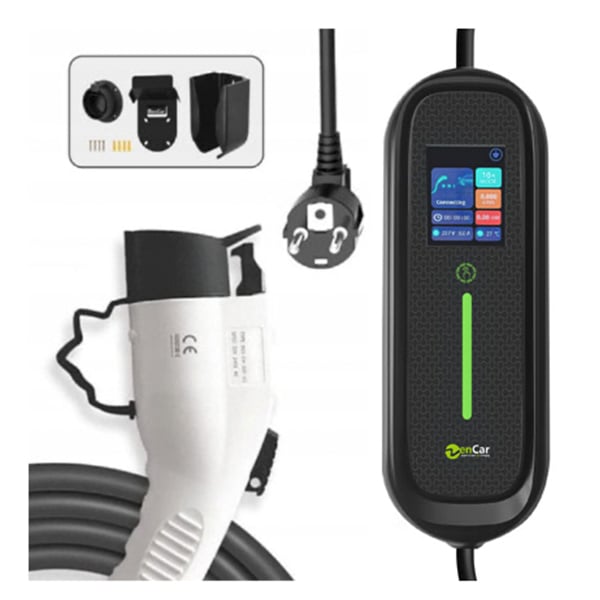
ZenCar model E - a portable charger with a Type 1 cable. It offers a power output of up to 3.6 kW, operates on a single-phase 230 V supply and allows the charging current to be adjusted between 6 and 16 A. The model features a 5.5 m cable, an LCD display, a delayed start function and an IP66 protection rating.
EV charger comparison – specification table
Objectively speaking, Akyga® products stand out from the competition thanks to their wide range of models and a practical approach to the day-to-day charging of electric cars. The range includes both portable chargers and wallboxes, as well as cables, adaptors and accessories, allowing users to put together a complete set tailored to their needs. Another major advantage is the excellent value for money – Akyga® chargers offer the most important specifications, safety features and ease of use without making operation unnecessarily complicated.
| Model | Power | Connector | Phases | Max. current | Cable Length | IP | Type |
|---|---|---|---|---|---|---|---|
| Akyga AK-EC-21 | 11 kW | Type 2 | 3 | 16 A | 5 m | IP54 | Wallbox |
| Akyga AK-EC-22 | 22 kW | Type 2 | 3 | 32 A | 5 m | IP54 | Portable |
| Akyga AK-EC-19 | 3,8 kW | Type 2 | 1 | 16 A | 5 m | IP54 | Portable |
| Akyga AK-EC-18 | 3,8 kW | Type 1 | 1 | 16 A | 5 m | IP54 | Portable |
| Akyga AK-EC-15 | 7,2 kW | Type 1 | 1 | 32 A | 5 m | IP54 | Portable |
| Wallbox Besen BS20-BC-11KW | 11 kW | Type 2 | 3 | 16 A | 6 m | IP66 | Wallbox |
| ZenCar model C30 | 22 kW | Type 2 | 3 | 32 A | 5 m | IP66 | Portable |
| GreenCell EV16 | 3.6 kW | Type 2 | 1 | 16 A | 6.5 m | IP66 | Portable |
| Dé deM2D07B6 | 7,4 kW | Type 2 | 1 | 32 A | 6 m | No data | Portable |
| ZenCar model E | 3.6 kW | Type 1 | 1 | 16 A | 5.5 m | IP66 | Portable |
Charging cables must have an IP44 protection rating or higher – all the chargers in this comparison meet this requirement. Standard cables are usually between 5 and 7 metres long, whilst in some bespoke configurations they can be as long as 10 metres. Furthermore, 3-phase cables are heavier and thicker, but allow for faster charging – this is particularly evident when comparing the weights of 11 kW and 22 kW units.

Which electric car charger is best for home use?
The choice of a home charger depends on several factors: the type of electrical installation (single-phase or three-phase), daily mileage, vehicle type and budget. For most users who charge their car overnight, even a power output of 3.6–7.2 kW is sufficient – an 8-hour charge will replenish up to 60 kWh of energy.
Home charger – wallbox or socket?
Charging from a Schuko socket (230V / 16A) is the simplest solution, but it only provides around 3.6 kW of power, which translates to approximately 18–30 km of range per hour. A 7.4 kW single-phase wallbox provides 37–62 km per hour, whilst a 11 kW three-phase wallbox provides 55–92 km of range per hour.
In terms of convenience, a wallbox is by far the better choice. The unit is permanently installed and ready for use whenever you want to plug in your car. There’s no need to take out a portable charger, unroll cables or search for a free socket every time. In addition, the wallbox uses a dedicated electrical connection, so it doesn’t put a strain on your home’s sockets during long charging sessions.
A wallbox can also have a positive impact on property value – the installation of a charging station is an increasingly sought-after feature among buyers of houses and flats with garages.
Cost of installing a wallbox
Components of the cost of installing a wallbox in Poland in 2026:
-
Device - an 11 kW wallbox costs between approx. 320 and 930 EUR, depending on the manufacturer and features
-
Electrical installation - cabling from the distribution board to the installation site, safety devices, and any necessary upgrading of the electrical system: 230–1400 EUR
-
Three-phase connection - if the house does not have a three-phase supply, the connection will need to be upgraded, which may cost an additional 100–1400 EUR
-
Qualified installation - the charger should be installed by an electrician with SEP certification; following installation, it is recommended that tests be carried out to detect any potential installation faults.
The payback period compared to charging at public stations is usually 1–3 years – domestic electricity tariffs are significantly lower than the rates charged by public charging station operators. You can read more about electric cars and how to charge them in our guide.

Portable electric car charger – when is it worth it?
A portable charger is a solution that works well in several specific scenarios:
-
No permanent parking space - residents of blocks of flats, terraced houses or those using communal car parks are unable to install a wallbox. A portable charger with a Schuko plug, such as the AK-EC-19, allows you to charge from any socket.
-
Frequent travel - a portable charger provides a backup in case there is no access to fast chargers along the route. In many hotels and guesthouses, you’ll find a CEE or Schuko socket, but rarely a wallbox.
-
A second car or a second home - instead of installing two wallboxes, a single portable charger can be used at both locations.
-
Vehicles with a Type 1 connector - owners of older electric cars with a Type 1 connector (Nissan Leaf, Mitsubishi i-MiEV) will find the dedicated AK-EC-18 and AK-EC-15 chargers in the Akyga® range.
A limitation of portable chargers is usually their lower power output compared to a wallbox – you won’t get more than 3.6 kW from a standard Schuko socket alone. However, some models, such as the AK-EC-12 with a 5-pin CEE plug, offer a full 11 kW – provided you have access to a suitable three-phase installation.
The mobile charger with ControlBox is a technologically advanced product featuring current regulation, parameter monitoring on an LCD display and a full range of safety features. It is not just an ordinary cable – it is a fully-fledged EVSE device, made from weather-resistant materials.